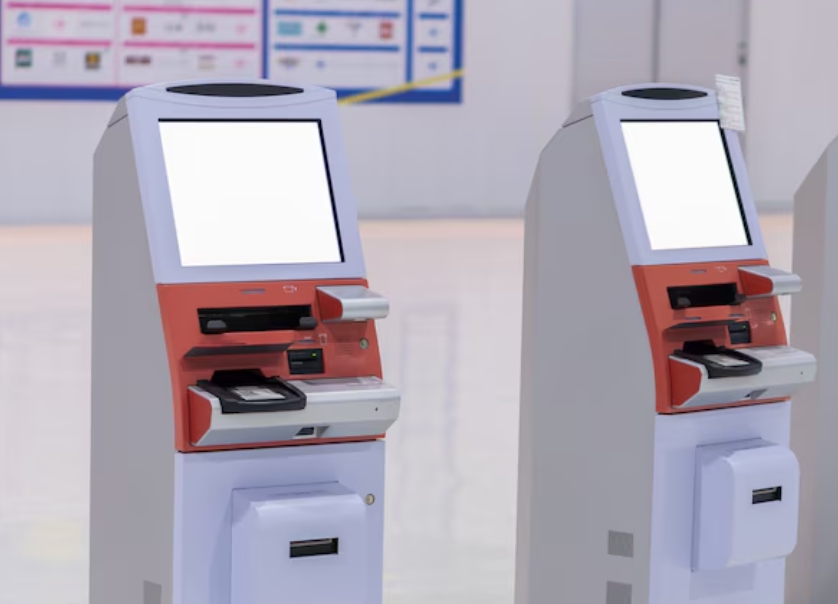
Public service terminals present fabrication challenges tied to their aesthetic and operational demands:
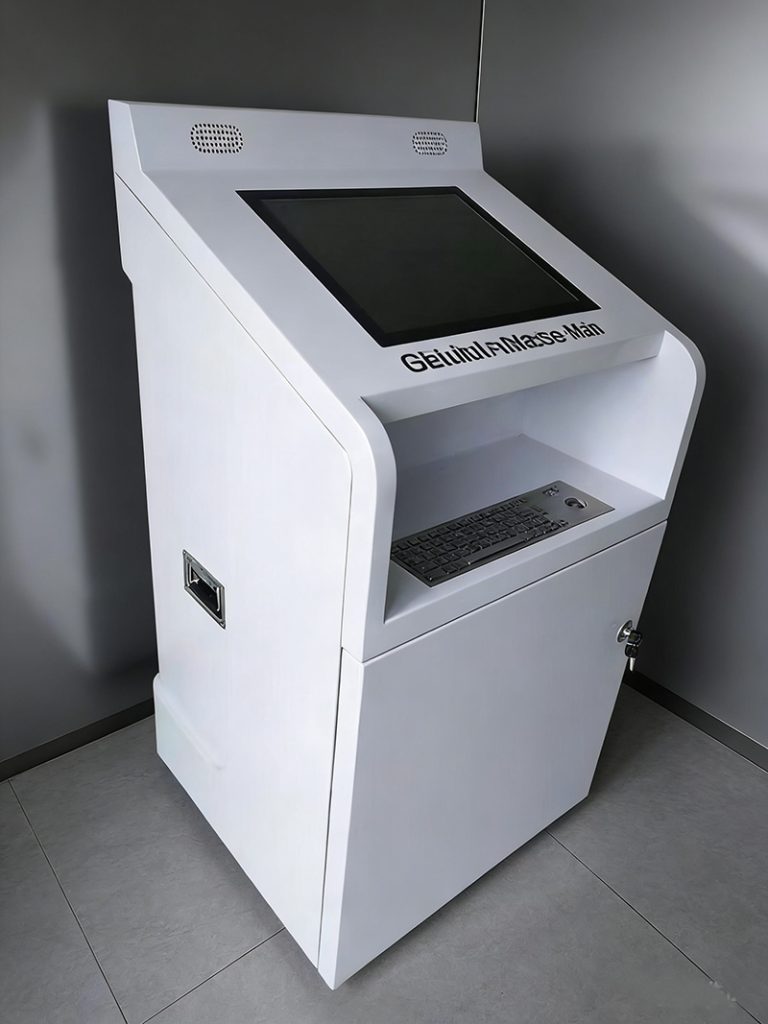
- Full-Arc Frame Uniformity:
Curved panels (the terminal’s signature design) require ±0.1° bend angle consistency—standard press brakes produce uneven arcs, leading to misaligned cabinet assemblies that delay deployment.
- Matte Finish Imperfection Visibility:
Flat-gloss (matte) coatings amplify even 0.03mm surface bumps under side lighting—generic fabrication results in visible defects that undermine the “professional public service” brand image.
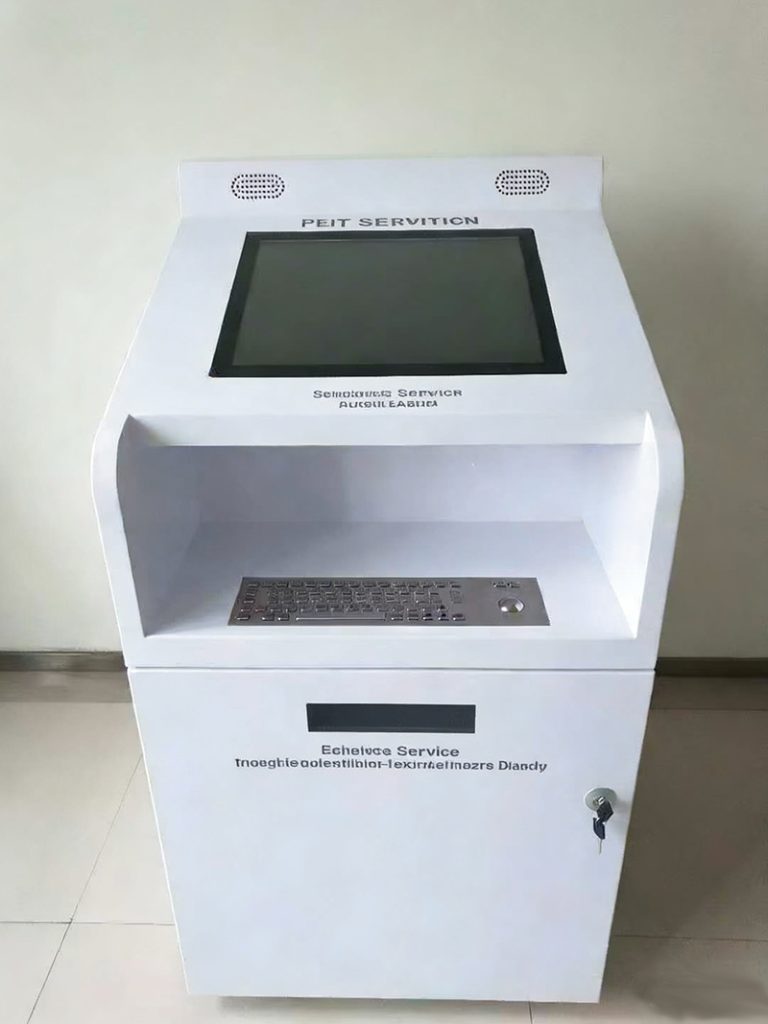
- Air-Spring Door Gap Control:
Lock-free air-spring doors need a 0.3mm max gap (to block dust) while opening smoothly—imprecise sheet metal fitting causes either gap leaks or door binding (common in 40% of off-the-shelf terminals).
- Public-Use Scratch Resistance:
Terminals in government lobbies face 8,000+ annual user touches—standard sheet metal coatings scratch within 6 months, requiring costly replacements.
- Multi-Device Integration Accuracy:
Cutouts for touchscreens, card readers, and printers need ±0.05mm tolerance—misalignments force on-site rework, delaying terminal rollouts by 7+ days.
We tailor fabrication to resolve these high-precision challenges, with a focus on arc quality, finish perfection, and door performance:
To achieve seamless, aligned curved structures:
- Advanced Bending Workflow:
- AMADA HG 1303 CNC press brakes (with 8-axis backgauges) to form 1.5mm SPCC cold-rolled steel into full arcs (radius: 60–150mm) with ±0.1° angle tolerance.
- Custom 3D-printed bend dies (shaped to the terminal’s arc profile) to eliminate springback (a top cause of arc inconsistency).
- Post-Bend Validation:
- CMM scanning of each arc panel to verify radius (±0.05mm) and bend angle (±0.1°) before assembly.
- Robotic deburring (150-grit abrasive) to smooth arc edges, preventing sharp points that risk user injury.
To deliver side-light-resistant, flaw-free surfaces:
- Pre-Coating Surface Preparation:
- 3-stage cleaning (degreasing → acid pickling → rinsing) to remove all surface contaminants; robotic sandblasting (100-grit media) to create a uniform 0.02mm texture (optimized for matte coating adhesion).
- Side-light inspection (500lux, 45° angle) to reject panels with ≥0.03mm bumps before coating.
- Robotic Matte Coating:
- High-pressure robotic powder coating (65μm thickness) with flat-gloss (5–8 GU) formulation—calibrated via a gloss meter to ensure no finish variation across panels.
- Controlled oven cooling (1.5°C/min rate) to prevent coating warping (a common cause of post-cure surface bumps).
To achieve 0.3mm gaps with smooth operation:
- Precision Door & Frame Fabrication:
- Laser-cut door panels (±0.03mm tolerance) with CNC-bent R2mm edges (matching the terminal’s arc).
- Frame recesses (CNC-machined) to seat SUSPA C16 air-spring hinges with ±0.02mm alignment.
- Gap Calibration:
- Adjustable hinge brackets (welded to the door) to fine-tune position; feeler gauge checks (0.3mm max) around the door perimeter.
- EPDM rubber gaskets (custom-cut to the door’s arc) to fill the gap while maintaining 10,000+ smooth opening cycles.
To ensure long-term performance and seamless user experience:
- Scratch-Resistant Materials:
- Main panels: 1.5mm SPCC steel with ceramic-reinforced matte coating (abrasion resistance: ≥10,000 cycles per JIS K 5600).
- High-contact areas (touchscreen bezel): 1.2mm 304 stainless steel (brushed finish) to resist 8,000+ annual touches.
- Micron-Level Device Cutouts:
4000W fiber laser cutting for 17–22-inch touchscreens (±0.05mm tolerance) and card readers (85mm×55mm cutouts)—ensuring perfect component fit without on-site rework.
Hidden 25×30mm cable channels (integrated into the arc frame) to organize wiring and block dust ingress.

Our processes prioritize precision and consistency for public service terminal deployments:
- Arc Design DFM Review:
Pre-production analysis to optimize bend sequences (reducing springback) and align arc profiles with air-spring door hardware.
- Automated Manufacturing:
- Robotic panel loading for press brakes to eliminate human error in arc bending.
- Robotic coating application to ensure uniform matte finish thickness (±2μm).
- Critical Quality Checks:
- Arc Uniformity: CMM verification of arc radius and angle (±0.05mm/±0.1°).
- Finish Perfection: Side-light inspection (no ≥0.03mm bumps).
- Door Performance: 1,000-cycle air-spring test + 0.3mm gap validation.
- Public-Space Packaging:
Arc-shaped foam inserts + ISPM 15 crates to protect the matte finish and arc panels during shipping to government facilities.
- Client: A Southeast Asian municipal government (300+ public service centers).
- Pain Points: Need for full-arc terminals with matte finishes, 0.3mm air-spring door gaps, and 25-day delivery for 600 units.
- Sanjun’s Solutions:
- AMADA 8-axis press brakes + 3D bend dies for uniform arcs.
- Robotic matte coating + side-light inspection for flaw-free surfaces.
- Precision air-spring door fitting with 0.3mm gap calibration.
- Outcomes:
- 0 assembly misalignment reports across 600 units.
- 99.7% of terminals passed side-light finish inspection.
- Air-spring doors operated smoothly with 0.28mm average gap (meeting IP54 standards).
Q: How do you ensure arc consistency across all terminal panels?
A: We use 8-axis press brakes with custom 3D bend dies and CMM post-bend scanning to maintain ±0.1° angle tolerance.
Q: Will the matte finish resist scratches in high-traffic lobbies?
A: Yes—our ceramic-reinforced coating (paired with 1.5mm SPCC steel) passes 10,000-cycle scratch tests (JIS K 5600).
Q: Lead time for 1,000-unit terminal orders?
A: Prototyping (10 units): 11–13 days; mass production + checks: 28–32 days (including arc and door gap validation).
Sanjun’s custom sheet metal solutions deliver the full-arc precision, flawless matte finishes, and tight air-spring door gaps required for public service terminals. Contact our team to share your terminal’s design specs and receive a tailored proposal.
Would you like me to compile a Public Service Terminal Sheet Metal Quality Checklist (covering arc tolerance, finish inspection, and door gap standards) to support your government deployment planning?



























Leave a comments