Project Background
With the global home improvement industry trending toward customization, durability, and eco-friendliness, a leading international kitchen furniture brand launched a 2026 customization project for 2,000 sets of precision sheet metal components for high-end kitchen cabinets. These components, including cabinet frames, drawer slides, countertop support brackets, and storage compartment dividers, were destined for high-end residential projects, boutique hotels, and commercial catering kitchens across Europe and North America.
Core requirements tailored to kitchen application scenarios included:
-
Moisture & corrosion resistance: Withstand long-term exposure to kitchen humidity, water splashes, and food-grade cleaning agents (e.g., dish soap, vinegar);
-
High load-bearing capacity: Cabinet frames and brackets must support ≥50kg weight (for countertop and storage items) without deformation;
-
Precision fitting: Dimensional tolerance ≤±0.5mm to ensure seamless assembly with wood, quartz, and other cabinet materials;
-
Eco-friendly & safe: Surface coatings comply with EU REACH and US CARB P2 standards, no harmful volatile organic compounds (VOCs) emission;
-
Aesthetic consistency: Uniform surface finish (matte black, brushed stainless steel) with color difference ΔE ≤1, matching high-end kitchen design styles;
-
Easy installation: Modular design to reduce on-site assembly time by 30% for construction teams.
Sanjun Hardware was selected for its rich experience in custom sheet metal manufacturing, mature surface treatment technology, and proven capability to balance functional performance with aesthetic requirements—key advantages for kitchen cabinet components that demand both practicality and visual appeal.
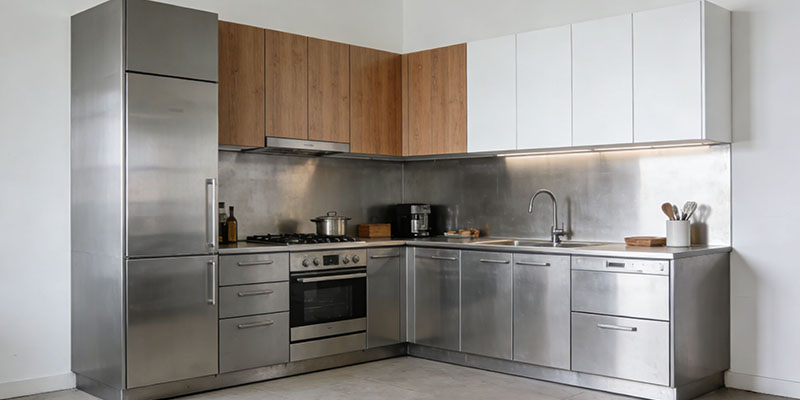
Manufacturing Process of Core Kitchen Cabinet Sheet Metal Components
Sanjun integrated kitchen-specific environmental and functional requirements into every production link, focusing on four core components: stainless steel cabinet frames, galvanized drawer slides, aluminum alloy support brackets, and powder-coated storage dividers. The production process strictly followed eco-friendly manufacturing standards to ensure product safety.
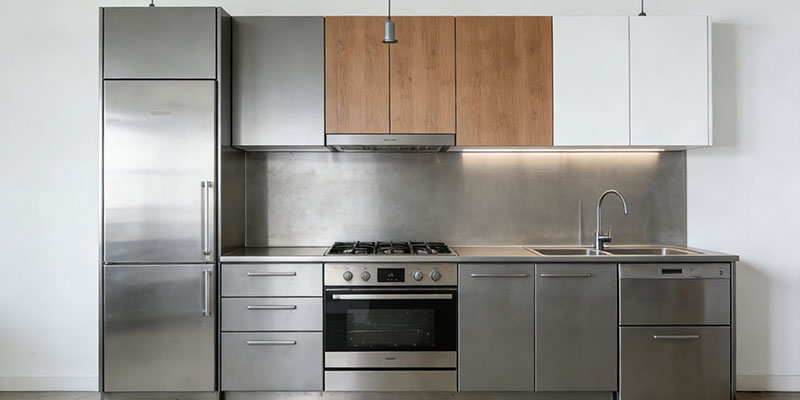
1. Material Selection & Pre-treatment
-
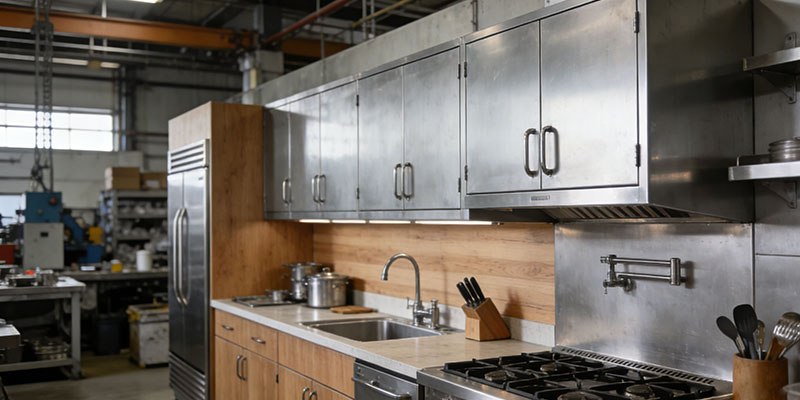
Cabinet Frames: 1.0mm 304 stainless steel—excellent moisture resistance, corrosion resistance, and mechanical strength, suitable for long-term use in humid kitchen environments;
-
Drawer Slides: 0.8mm galvanized SPCC cold-rolled steel—enhanced rust prevention and smooth sliding performance, with a service life of ≥10,000 opening-closing cycles;
-
Support Brackets: 1.2mm 6063-T5 aluminum alloy—lightweight, high load-bearing capacity, and good machinability, reducing overall cabinet weight while ensuring stability;
-
Storage Dividers: 0.6mm SPCC cold-rolled steel with eco-friendly powder coating—cost-effective and aesthetic, suitable for internal storage partitioning;
-
Pre-treatment: Automated degreasing + phosphating treatment + passivation—removing surface oil stains and rust, forming a protective film to enhance coating adhesion and corrosion resistance.
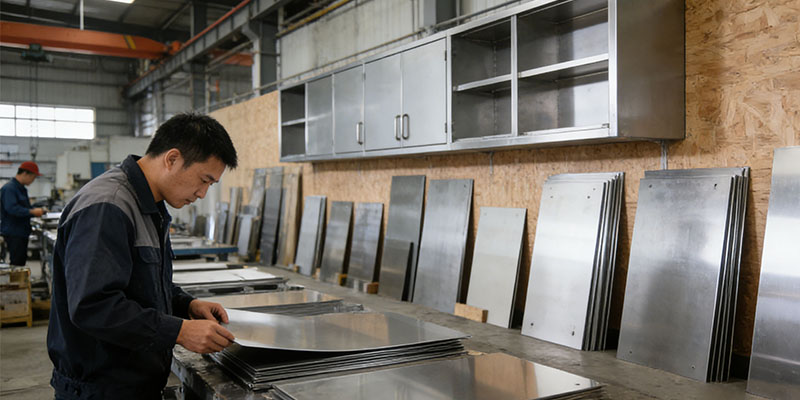
2. Core Manufacturing Craftsmanship
-
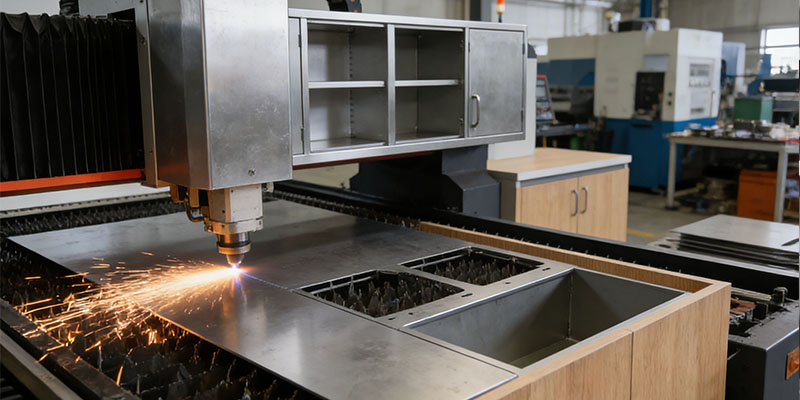
Precision Laser Cutting: 3000W fiber laser cutting machine (±0.1mm tolerance)—processing holes and notches for assembly on cabinet frames and brackets. The cutting process adopted dust collection equipment to ensure surface cleanliness;
-
CNC Bending & Forming: 6-axis CNC bending machine with custom jigs—forming cabinet frame profiles and bracket shapes. Springback was controlled within ≤0.2mm through parameter optimization, ensuring dimensional accuracy for seamless assembly;
-
Spot Welding & Riveting: Automated spot welding machine (weld spot diameter 3-5mm)—reinforcing cabinet frame joints without damaging the surface. Riveting was used for drawer slide components to ensure stable connection and smooth sliding;
-
Surface Treatment:
-
Cabinet Frames: Brushed finish + anti-fingerprint coating—enhancing aesthetic appeal and easy to clean;
-
Drawer Slides: Electro-galvanizing (zinc layer thickness ≥8μm)—superior rust prevention, complying with salt spray test requirements for ≥96 hours;
-
Support Brackets & Dividers: Electrostatic powder coating (coating thickness 50-70μm)—adopting eco-friendly epoxy-polyester powder, with 9H hardness, scratch resistance, and no VOCs emission. Colors included matte black and brushed silver to match client design needs;
-
Post-treatment: Edge deburring and polishing—removing sharp edges to avoid scratches during installation and use.
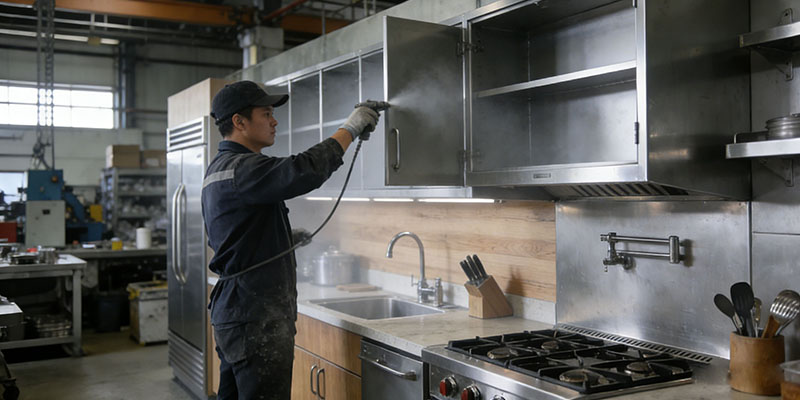
3. Quality Control & Testing
-
Dimensional Inspection: Coordinate Measuring Machine (CMM) and digital calipers—100% inspection of key dimensions (frame width, bracket hole spacing) to ensure assembly precision;
-
Functional Testing: Load-bearing test (cabinet frames and brackets loaded with 60kg for 24 hours, no deformation); drawer slide sliding test (10,000 cycles, smooth without jamming);
-
Corrosion Resistance Test: Salt spray test (cabinet frames ≥480 hours, drawer slides ≥96 hours, no rust); humidity test (simulating 90% humidity environment for 72 hours, no surface damage);
-
Eco-friendly Inspection: Third-party testing for VOCs emission and heavy metal content—complying with EU REACH and US CARB P2 standards;
-
Aesthetic Inspection: Visual inspection of surface finish and color difference detection (ΔE ≤1) to ensure consistent appearance.
Project Challenges & Sanjun’s Solutions
1. Challenge: Moisture Resistance in Kitchen Environments
Ordinary sheet metal components were prone to rust and corrosion in long-term humid kitchen environments, affecting service life and aesthetic appeal.
Solution: Selected 304 stainless steel for core load-bearing components and adopted multi-layer anti-corrosion treatment (pre-treatment + passivation + specialized coating). Conducted accelerated aging tests (simulating 5 years of kitchen use) to verify corrosion resistance. The final products passed 480-hour salt spray tests without rust, meeting long-term use requirements.
2. Challenge: Balancing Load-Bearing Capacity with Lightweight Design
The client required cabinet components to have high load-bearing capacity while being lightweight to reduce the burden on cabinet panels and installation structures.
Solution: Optimized material selection and structural design—used high-strength aluminum alloy for support brackets to reduce weight by 25% compared to steel brackets. Adopted reinforced rib structures on cabinet frames through finite element analysis (FEA) to enhance load-bearing capacity without increasing material thickness. The final components achieved a load-bearing capacity of ≥55kg while reducing overall weight by 20%.
3. Challenge: Dimensional Consistency for Modular Assembly
The modular design required strict dimensional consistency of 2,000 sets of components to ensure seamless assembly across different batches and project sites.
Solution: Adopted automated production equipment (laser cutting, CNC bending) to reduce manual operation errors. Established a batch inspection system—100% inspection of the first 20 units of each batch, and random inspection of 5% of subsequent units. If dimensional deviation exceeded ±0.3mm, the entire batch was reworked. The final dimensional consistency of all components was controlled within ±0.2mm, ensuring smooth modular assembly.
4. Challenge: Aesthetic Consistency of Surface Finish
The high-end kitchen market required strict color consistency of components, and color difference was prone to occur in large-batch powder coating.
Solution: Used automated electrostatic spraying equipment and unified powder batches. Established a color management database—recorded spraying parameters (voltage, temperature, time) for each color, and conducted color difference detection before each batch production. The final color difference of all products was controlled within ΔE ≤0.8, meeting the client’s aesthetic requirements.
Project Outcomes
-
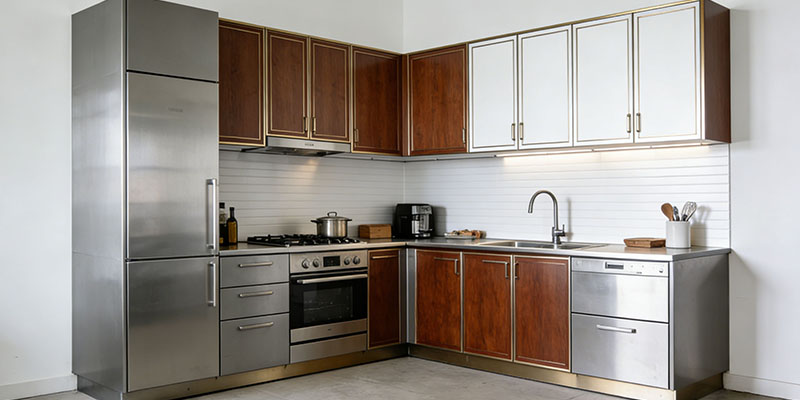
Delivery Performance: 2,000 sets of kitchen cabinet sheet metal components were delivered 3 days ahead of the 30-day deadline, with a 100% pass rate in pre-delivery inspection (including dimensional accuracy, corrosion resistance, load-bearing capacity, and eco-friendly testing);
-
Market Feedback: After 9 months of application in 500+ high-end residential and commercial projects, the components showed 0 cases of rust, deformation, or coating peeling. The client reported high satisfaction with assembly efficiency and product durability, with a 15% increase in customer praise for cabinet quality;
-
Long-Term Cooperation: The kitchen furniture brand signed a 2-year strategic cooperation agreement with Sanjun Hardware, entrusting it with sheet metal customization for 4 new kitchen cabinet series. The client cited Sanjun’s “deep understanding of kitchen product pain points, reliable product quality, and efficient delivery capability” as key cooperation drivers.