Project Background
With the global medical device industry advancing toward miniaturization, intelligence, and high reliability, a leading medical equipment manufacturer initiated a customization project for 1,500 precision sheet metal enclosures in 2026. These enclosures were designed for core components of in-vitro diagnostic (IVD) devices and minimally invasive surgical instruments, deployed in tertiary hospitals, independent laboratories, and mobile medical units worldwide.
Core requirements tailored to medical device standards included:
-
Strict medical compliance: Conform to ISO 13485:2016 medical device quality management system, FDA 21 CFR Part 820, and biocompatibility certification (ISO 10993);
-
Ultra-high precision: Dimensional tolerance ≤±0.02mm to fit sensitive electronic components (e.g., sensors, circuit boards) of medical devices;
-
Contamination resistance: Withstand frequent disinfection (alcohol, hydrogen peroxide) and maintain structural integrity in cleanroom environments (Class 8);
-
Electromagnetic compatibility (EMC): Meet IEC 60601-1-2 EMC standards to avoid interfering with device signal transmission;
-
Batch consistency: Uniform material composition, dimension, and surface finish (ΔE ≤0.8) to ensure stable assembly and clinical application.
Sanjun Hardware was selected for its rich experience in high-precision sheet metal customization, mature medical-grade quality control system, and successful track record in balancing technical functionality with industry compliance requirements.
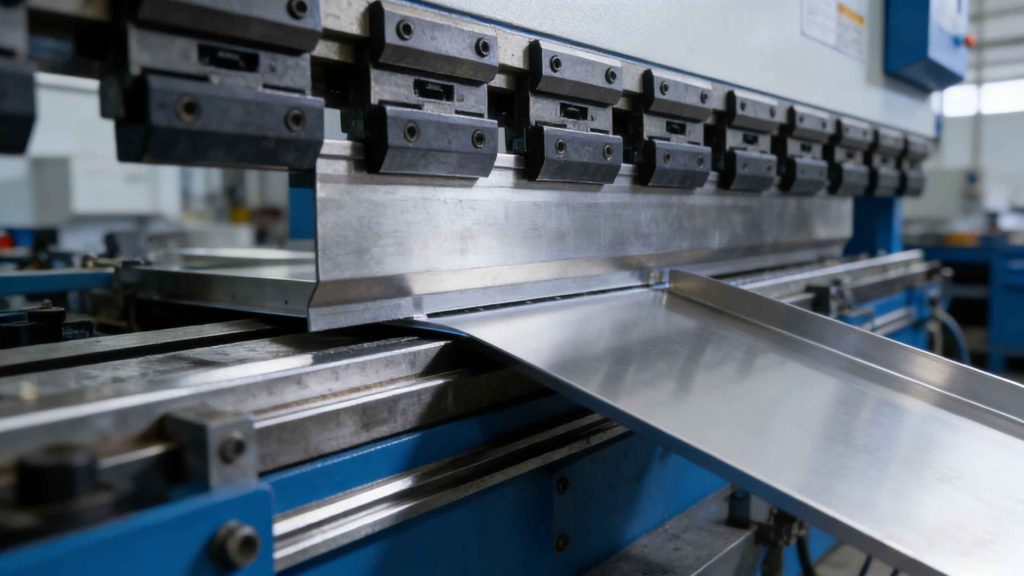
Manufacturing Process of Core Medical Sheet Metal Components
Sanjun integrated medical device-specific requirements into the entire production chain, focusing on three core components of the enclosure: the sealed main body, precision interface panel, and EMC shielding cover. The manufacturing process adhered to clean production standards to avoid cross-contamination.
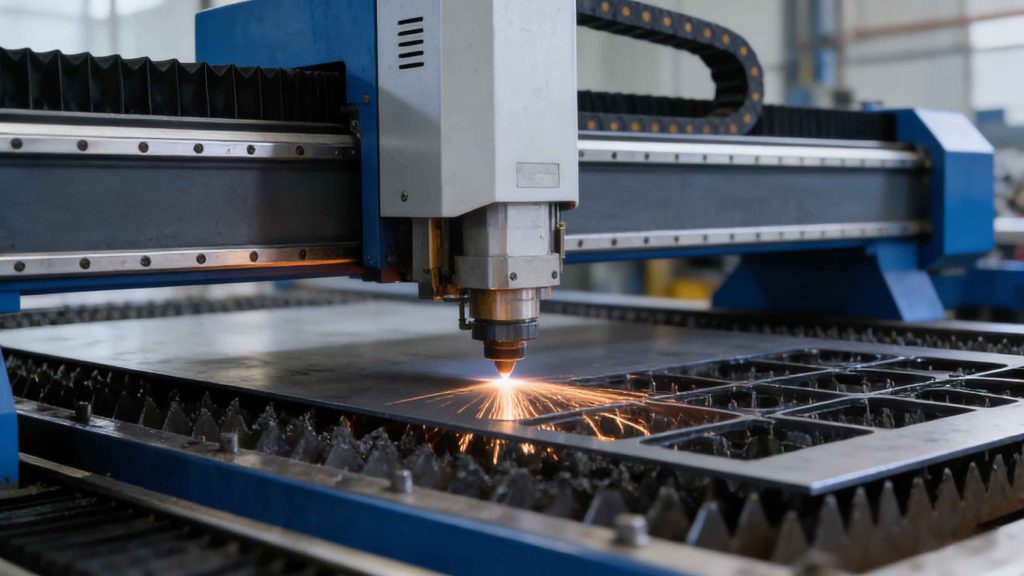
1. Material Selection & Pre-treatment
-
Sealed Main Body: 1.5mm 316L medical-grade stainless steel—excellent corrosion resistance, biocompatibility, and mechanical strength, suitable for long-term contact with medical reagents and disinfection agents;
-
Precision Interface Panel: 1.2mm 5052 aluminum alloy—lightweight, good thermal conductivity, and easy to process high-precision holes for sensor and data interface;
-
EMC Shielding Cover: 0.8mm SPCC cold-rolled steel with conductive nickel plating—high shielding effectiveness to block electromagnetic interference;
-
Pre-treatment: Ultrasonic cleaning (degreasing, decontamination) in a Class 8 cleanroom + passivation treatment—removing surface impurities and enhancing corrosion resistance without affecting biocompatibility.
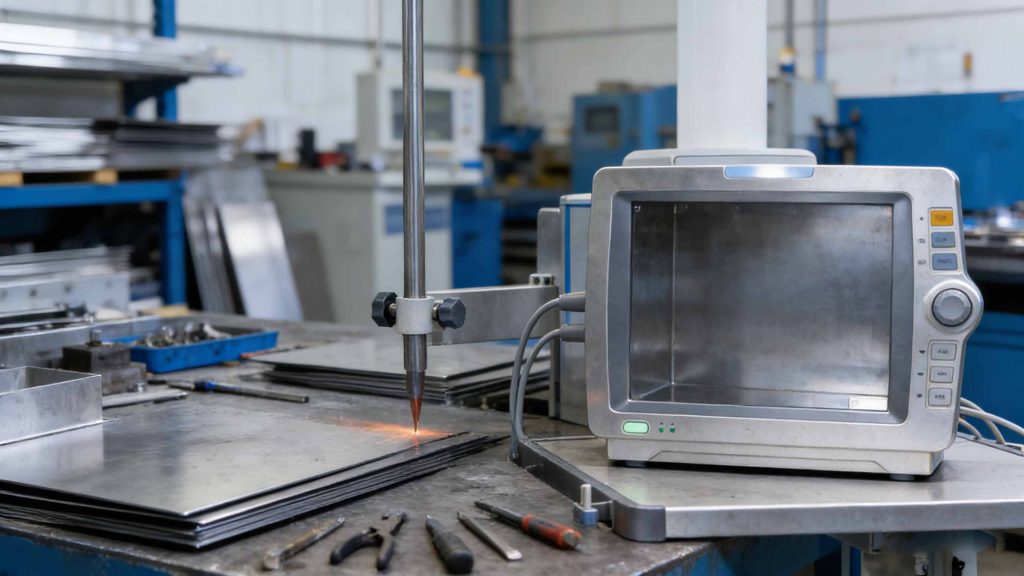
2. Core Manufacturing Craftsmanship
-
Precision Laser Cutting: 6000W fiber laser cutting machine with ±0.01mm positioning accuracy—processing high-precision holes (diameter tolerance ±0.015mm) and complex contours on the interface panel. The cutting process was performed in a dust-free workshop to avoid particle adhesion;
-
CNC Precision Bending: 12-axis AMADA CNC bending machine with custom 3D-printed jigs—forming the sealed main body and shielding cover. Springback was controlled within ≤0.03mm through real-time parameter adjustment, ensuring the enclosure’s sealing performance;
-
Laser Welding: 2000W fiber laser welding with automatic tracking system—welding the main body seams with a weld width of 0.8mm. The welding process adopted argon protection to prevent oxidation, and the weld seam was smooth without burrs to avoid dead corners for contamination;
-
Surface Treatment:
-
316L Stainless Steel Main Body: Electropolishing treatment—reducing surface roughness to Ra ≤0.2μm, enhancing corrosion resistance and easy cleaning;
-
Aluminum Alloy Interface Panel: Anodizing (thickness 15-20μm) + anti-fingerprint coating—improving wear resistance and avoiding secondary pollution from fingerprints;
-
Shielding Cover: Conductive nickel plating (thickness 8-10μm)—ensuring EMC shielding effectiveness ≥45dB.
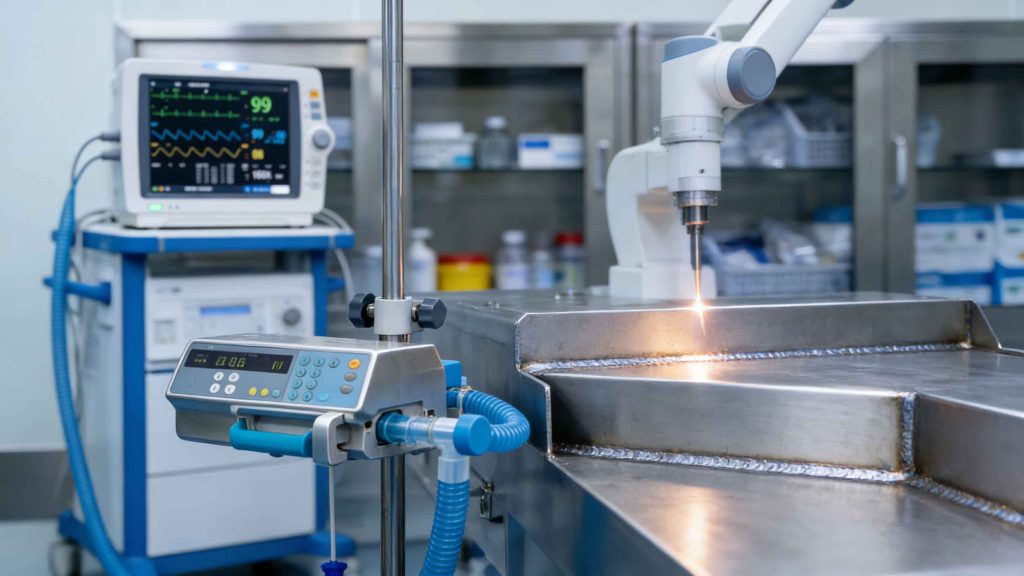
3. Medical-Grade Quality Control
-
Dimensional Inspection: Coordinate Measuring Machine (CMM) with 0.001mm precision—100% inspection of key dimensions (interface holes, enclosure parallelism) of each unit; 3D scanning for overall contour verification;
-
Functional Testing: Sealing test (pressure 0.3MPa, no air leakage for 30 minutes); EMC testing (radiated emission ≤30dBμV/m); disinfection resistance test (1000 cycles of alcohol spraying, no surface damage);
-
Compliance Verification: Third-party testing for biocompatibility (cytotoxicity, skin irritation) and material composition (conforming to medical-grade material standards); complete traceability of raw material certificates and production records.
Project Challenges & Sanjun’s Solutions
1. Challenge: Balancing Ultra-High Precision with Production Efficiency
The ±0.02mm dimensional tolerance requirement was far stricter than industrial standards, and mass production was prone to dimensional deviation due to material deformation.
Solution: Adopted “pre-deformation compensation + real-time monitoring” strategy. First, simulated material deformation during processing via finite element analysis (FEA) to set pre-compensation parameters for cutting and bending. Second, installed online vision inspection systems in the production line to monitor key dimensions in real time, adjusting processing parameters immediately if deviations were detected. The final pass rate of dimensional inspection reached 100%.
2. Challenge: Ensuring Cleanliness in Production Process
Medical devices require enclosures to be free of particle contamination, which is difficult to control in traditional sheet metal production.
Solution: Upgraded the production workshop to Class 8 cleanroom standards, equipped with air purification and dust removal systems. All production tools (jigs, molds) were cleaned and disinfected before use. Workers wore anti-static cleanroom clothing, and the production process adopted closed transfer of workpieces to avoid secondary contamination. The final product passed particle count testing (≤100 particles/m³ of 0.5μm and larger particles).
3. Challenge: Meeting Strict EMC Requirements for Medical Devices
Electromagnetic interference could affect the accuracy of diagnostic data and surgical instrument operation, and the enclosure’s shielding effectiveness was critical.
Solution: Optimized the enclosure structure design—added conductive gaskets at the joint of the main body and cover, and designed a full-surface conductive coating for the shielding cover. Conducted multiple EMC simulation tests during the R&D phase to adjust the structure and coating parameters. The final product’s EMC shielding effectiveness reached ≥50dB, exceeding the IEC 60601-1-2 standard requirement.
4. Challenge: Batch Consistency of Surface Finish
The client required ΔE ≤0.8 for surface color difference, which was challenging to control in mass production of different batches.
Solution: Adopted automated surface treatment equipment and unified raw material batches. Established a color management system—conducted color difference detection for each batch of products (100% inspection for the first 10 units, random inspection for subsequent units at 5% ratio). If the color difference exceeded the standard, the entire batch was reworked. The final color difference of all 1,500 units was controlled within ΔE ≤0.6.
Project Outcomes
-
Delivery Performance: 1,500 medical sheet metal enclosures were delivered 5 days ahead of the 40-day deadline, with a 100% pass rate in pre-delivery inspection (including compliance certification, dimensional accuracy, and functional testing);
-
Clinical Application Feedback: After 12 months of application in 300+ medical institutions worldwide, the enclosures showed 0 cases of corrosion, contamination, or EMC failure. The client reported that the enclosures effectively guaranteed the stable operation of medical devices;
-
Long-Term Cooperation: The manufacturer signed a 3-year long-term cooperation agreement with Sanjun Hardware, entrusting it with the sheet metal customization business for 3 new types of medical devices, citing Sanjun’s “professional ability to deeply understand medical industry pain points and strictly comply with global medical standards.”