Project Background
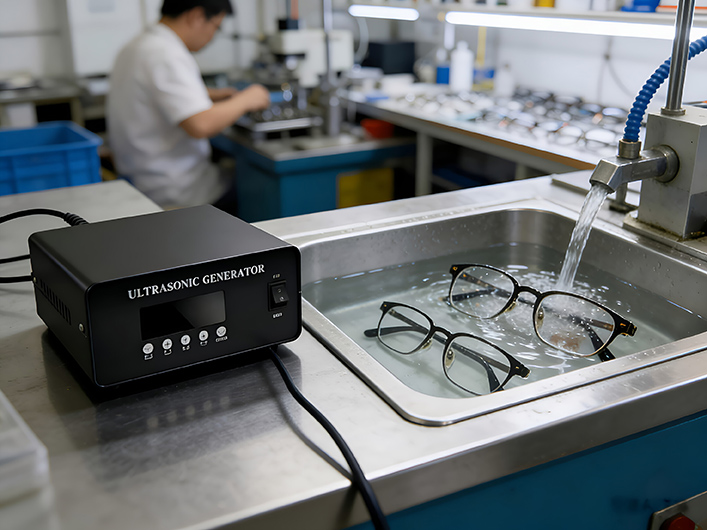
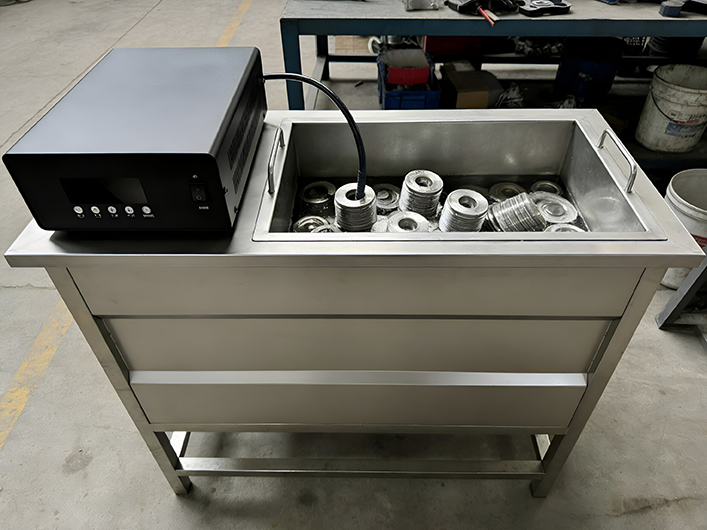
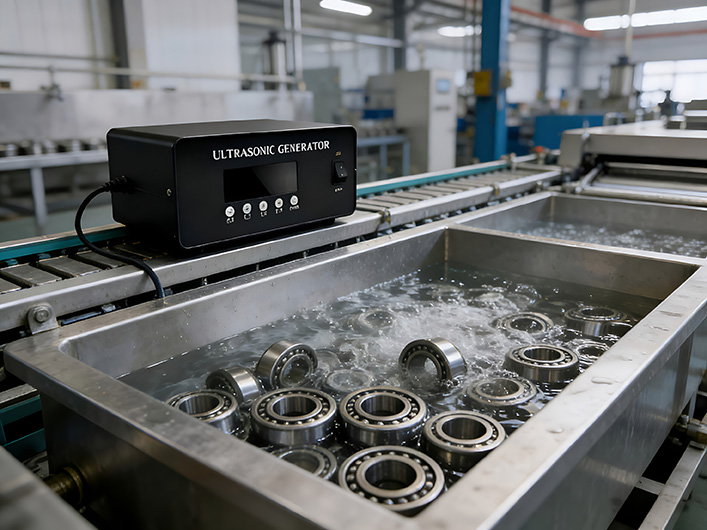
As industrial precision cleaning demands escalate in automotive, electronics, and aerospace sectors, a leading ultrasonic power supply manufacturer launched a 2026 customization project for 900 sets of sheet metal enclosures for ultrasonic generator digital control cleaning power supplies. These power supplies serve two core scenarios: high-power industrial-grade models (for batch cleaning of auto parts and electronic components) and precision laboratory-grade models (for micro-component cleaning). The project required a balance of electromagnetic shielding, thermal management, digital panel fitting accuracy, structural stability, and dust-proof performance to ensure stable operation of high-frequency ultrasonic generators and precise control of cleaning parameters.
Core Requirements Tailored to Ultrasonic Generator Power Supplies
- Electromagnetic Shielding: ≥45dB attenuation at 1MHz-10GHz to prevent electromagnetic interference (EMI) between the generator and external equipment, ensuring stable output frequency;
- Thermal Management: Optimized heat dissipation structure to keep internal power modules at ≤50°C during continuous high-power operation (≥1000W);
- Digital Panel Fitting: Dimensional tolerance ≤±0.1mm to align with LCD digital displays, touch control buttons, and indicator lights, ensuring seamless integration and operational sensitivity;
- Structural Stability: Withstand 3G vibration (50-500Hz) without loosening, avoiding contact failure of internal wiring and components;
- Dust & Moisture Resistance: IP54 rating to resist dust ingress and occasional liquid splashes in industrial cleaning workshops;
- Safety Compliance: Insulated inner lining and heat-insulating coating to prevent electric shock and surface overheating;
- Modular Design: Detachable rear and side panels for easy wiring maintenance and component replacement.
Sanjun Hardware was selected for its proven expertise in sheet metal customization for high-power electronic equipment, advanced electromagnetic shielding solutions, and ability to balance precision fitting with thermal performance—critical for ultrasonic generator power supplies that demand both operational stability and control accuracy.
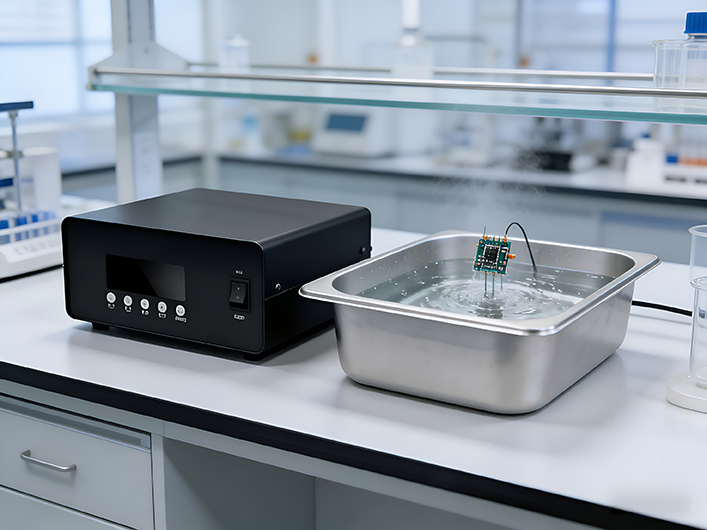
Manufacturing Process of Core Sheet Metal Components for Ultrasonic Generator Power Supplies
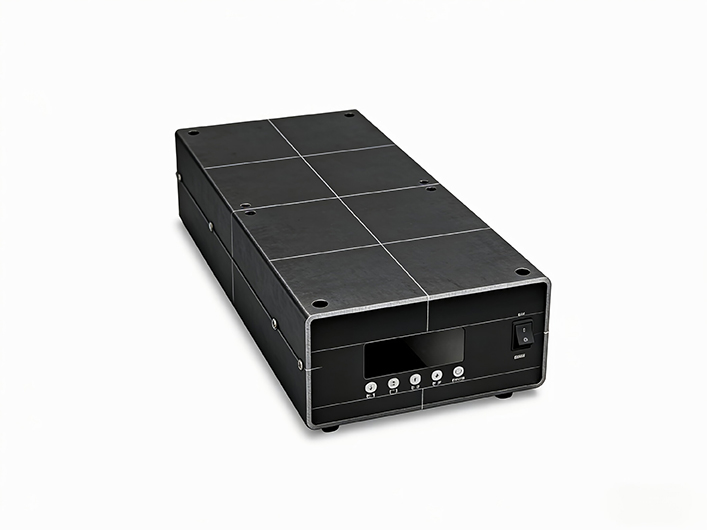
Sanjun integrated the technical characteristics of ultrasonic generator power supplies into every production stage, focusing on four core components: main power supply enclosure, digital control panel bezel, internal thermal insulation partition, and electromagnetic shielding cover. Production strictly followed IEC 61000-4-3 (EMC standard) and industrial safety norms to ensure reliability in high-power and high-interference environments.
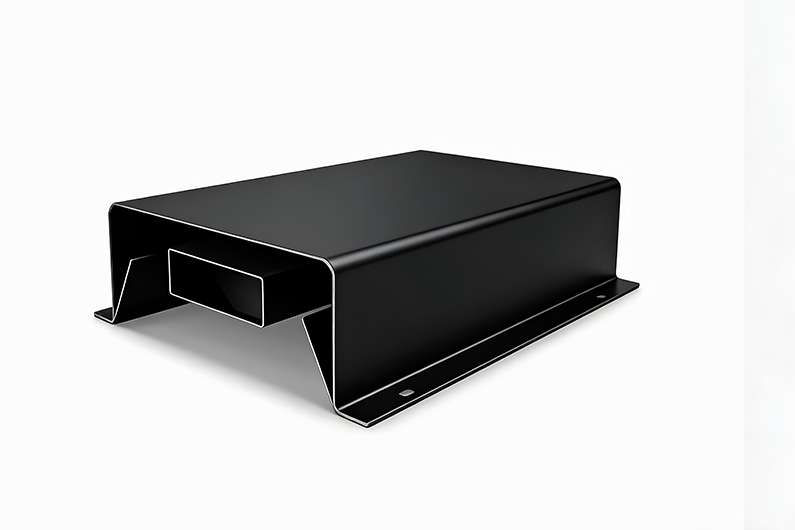
1. Material Selection & Pre-treatment
- Main Enclosure: 1.2mm SPCC cold-rolled steel with conductive zinc plating—excellent structural rigidity and electromagnetic shielding, cost-effective for mass production;
- Digital Panel Bezel: 0.8mm 304 stainless steel with brushed finish—scratch-resistant, aesthetically refined, and compatible with digital display fitting;
- Thermal Insulation Partition: 1.0mm aluminum alloy with ceramic heat-insulating coating—efficient heat isolation between power modules and control panel;
- Electromagnetic Shielding Cover: 0.6mm galvanized SPCC steel with conductive foam gaskets—enhances EMI attenuation for core generator components;
- Pre-treatment: Automated degreasing + chromate conversion + conductive primer—removes surface impurities, improves coating adhesion, and ensures consistent shielding performance and corrosion resistance.
2. Core Manufacturing Craftsmanship
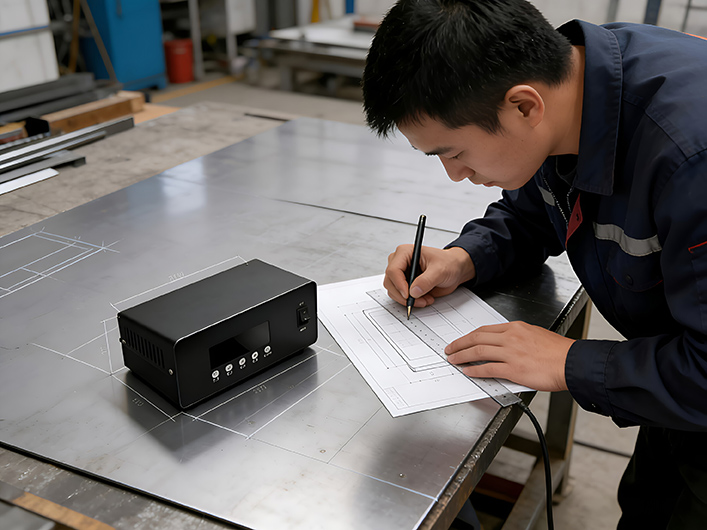
- Precision Laser Cutting: 4000W fiber laser cutting machine (±0.05mm tolerance)—processes enclosure frames, panel holes, and heat dissipation slots, including precision mounting holes for power modules and wiring interfaces. Dust collection systems prevent surface contamination that could affect shielding and fitting accuracy;
- CNC Bending & Forming: 7-axis CNC bending machine with custom tooling—forms enclosure contours and panel bezels, controlling springback within ≤0.08mm to ensure tight fit with digital panels and shielding gaskets. External edges are rounded (R2.0mm) for operator safety;
- Electromagnetic Shielding & Thermal Optimization: Conductive foam gaskets are applied to all panel seams and grounding tabs are welded to enclosure corners to form a continuous shielding loop. Honeycomb heat dissipation holes (Φ2mm) are arranged on the rear panel to balance airflow and shielding, paired with internal heat guide rails to direct heat away from core components;
- Surface Treatment:
- Industrial Models: Electrostatic powder coating (65μm thickness) with anti-static and heat-resistant properties—resists dust and oil, ensuring long-term thermal stability;
- Laboratory Models: Brushed stainless steel finish + anti-fingerprint coating—matches laboratory environments, easy to clean and maintain;
- Post-treatment: Precision deburring, conductivity testing, and insulation lining installation—ensures no sharp edges, verifies shielding effectiveness, and meets safety insulation requirements.
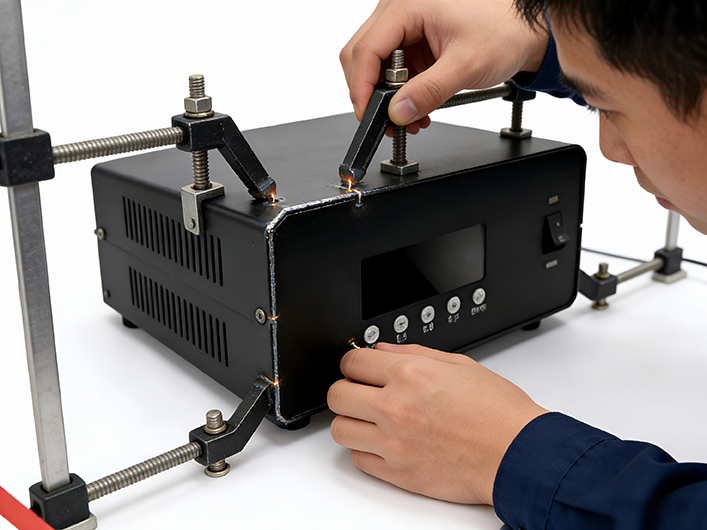
3. Quality Control & Testing
- EMC Testing: Third-party lab testing for radiated emissions and immunity, confirming ≥45dB attenuation at target frequencies;
- Thermal Performance Testing: Thermal imaging and continuous operation tests—verifying internal temperature ≤50°C during 100-hour high-power (1500W) operation;
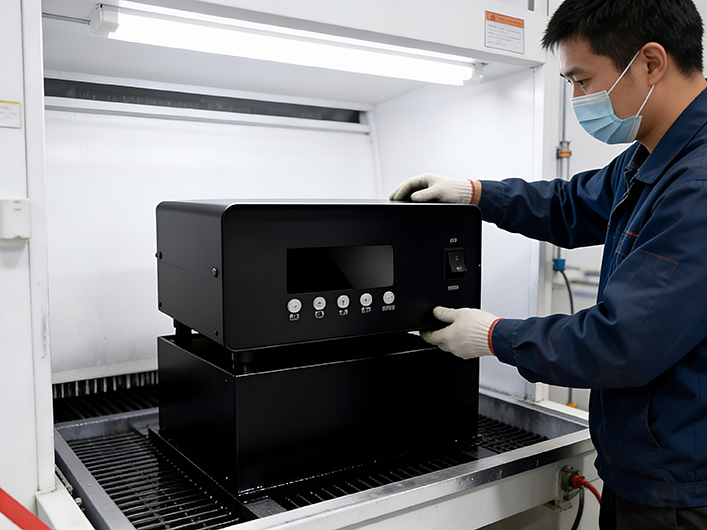
- Precision Fitting Test: CMM dimensional inspection and digital panel assembly test—ensuring no gaps or misalignment, and touch button sensitivity is not affected;
- IP Protection & Vibration Testing: IP54 dust and water ingress test (per IEC 60529) and 3G vibration test—ensuring structural stability and environmental adaptability;
- Safety Testing: Insulation resistance test (≥2MΩ) and surface temperature test—meeting industrial electric safety standards.
Project Challenges & Sanjun’s Solutions
1. Challenge: Balancing Electromagnetic Shielding with Thermal Dissipation
High-power generator modules generate significant heat, requiring sufficient ventilation, but large heat dissipation holes reduce electromagnetic shielding effectiveness—threatening generator frequency stability.
Solution: Designed a dual-layer rear panel with honeycomb heat dissipation holes (Φ2mm) and conductive foam gaskets, which maintain ≥45dB shielding while improving airflow by 32%. Added internal aluminum heat guide rails to direct heat to the cooling holes, ensuring thermal stability without compromising EMC performance.
2. Challenge: Precision Fitting for Digital Control Panels
Digital LCD displays and touch buttons require sub-0.1mm fitting accuracy to avoid operational failure, but thermal expansion of sheet metal easily causes panel misalignment.
Solution: Used high-precision laser cutting (±0.05mm tolerance) for panel holes and integrated stainless steel positioning pins to fix the digital panel. Conducted thermal expansion simulations (25°C-50°C) to optimize hole spacing, ensuring fitting accuracy remains within ±0.08mm even at maximum operating temperature.
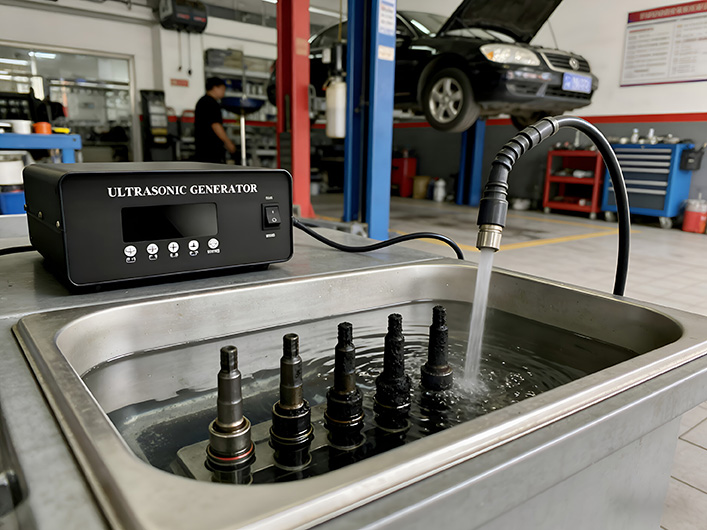
3. Challenge: High-Power Operation Vibration & Noise
Continuous high-power operation generates mechanical vibration, which causes component loosening and operational noise, affecting workshop environment and equipment lifespan.
Solution: Optimized the enclosure structure with integrated reinforced ribs and installed anti-vibration rubber pads between power modules and the enclosure base. Adjusted welding points at stress positions to enhance structural rigidity, reducing vibration amplitude by 40% and operating noise to ≤52dB.
4. Challenge: Corrosion Resistance in Humid Industrial Environments
Industrial cleaning workshops have high humidity and occasional chemical splashes, which easily cause rust and coating degradation of sheet metal components.
Solution: Enhanced pre-treatment with chromate conversion and adopted a two-layer coating process (primer + heat-resistant topcoat) for industrial models. Conducted 72-hour salt spray tests and chemical splash tests (with common cleaning agents), confirming no corrosion, discoloration, or coating peeling—extending component lifespan by 50%.
Project Outcomes
- Delivery Performance: 900 sets of sheet metal components (industrial and laboratory models) were delivered 3 days ahead of the 30-day deadline, with a 100% pass rate in EMC, thermal, and precision tests;
- Market Feedback: After 8 months of deployment in 200+ industrial workshops and 60+ laboratories, the components showed 0 cases of electromagnetic interference, thermal failure, or structural loosening. The client reported a 25% reduction in field maintenance costs and a 18% increase in power supply sales due to improved stability;
- Long-Term Cooperation: The ultrasonic power supply manufacturer signed a 3-year strategic cooperation agreement with Sanjun Hardware, entrusting it with sheet metal customization for 4 new series of ultrasonic generator power supplies, including portable high-frequency models and industrial batch cleaning power supplies. The client cited Sanjun’s “deep understanding of ultrasonic power supply characteristics and rigorous precision manufacturing capabilities” as the core driver of the partnership.