Air Bending vs Bottom Bending for Precision Sheet Metal Parts – SanJun Hardware

Nullam dignissim, ante scelerisque the is euismod fermentum odio sem semper the is erat, a feugiat leo urna eget eros. Duis Aenean a imperdiet risus.

Air Bending vs Bottom Bending for Precision Sheet Metal Parts

Air Bending vs Bottom Bending for Precision Sheet Metal Parts

Introduction: The Foundation of Precision Fabrication

Modern technology relies on strong outer cases, from hospital kiosks to charging stations for electric vehicles. The shell must match the quality of the inside parts. A weak structure can cause equipment failure, part damage, or poor appearance that customers reject today. Sheet metal bending sits at the center of building these tough, exact, and good-looking cases. Not every bending way works the same. For companies that need steady strength and perfect hardware fit, picking between “Air Bending” and “Bottom Bending” matters a lot. It affects accuracy, price, and how fast the product reaches the market.

The Critical Role of Bending in Modern Enclosures

Sheet metal work turns flat sheets into 3D shapes through steps like cutting, bending, and joining. The bending part creates the final form. It needs careful control of pressure and angle to get the right shape without warping or breaks. This accuracy is required for items like the Hospital Self-Service Kiosk Enclosure and IP65 Self-service Terminal Integrated Machine Shells. Those must hold delicate parts such as printers, screens, and card readers without gaps.

San Jun Hardware: Masters of Sheet Metal Geometry

San Jun Hardware focuses on making parts and cases for demanding fields like display, education, medical, power, home, and new energy uses. The company started in 2010. It runs a 5,000 square meter plant with modern tools, including AMADA CNC press brakes and fiber laser cutters. This shows its focus on top-quality sheet metal items. Our skill comes from choosing the right bending method. That way, each custom part matches your plans exactly, speeds up delivery, and improves the supply line.

The Mechanics of Sheet Metal Bending

Before comparing air and bottom bending, grasp the basic way sheet metal bends on a press brake.

The Press Brake: The Essential Tool for Shaping Metal

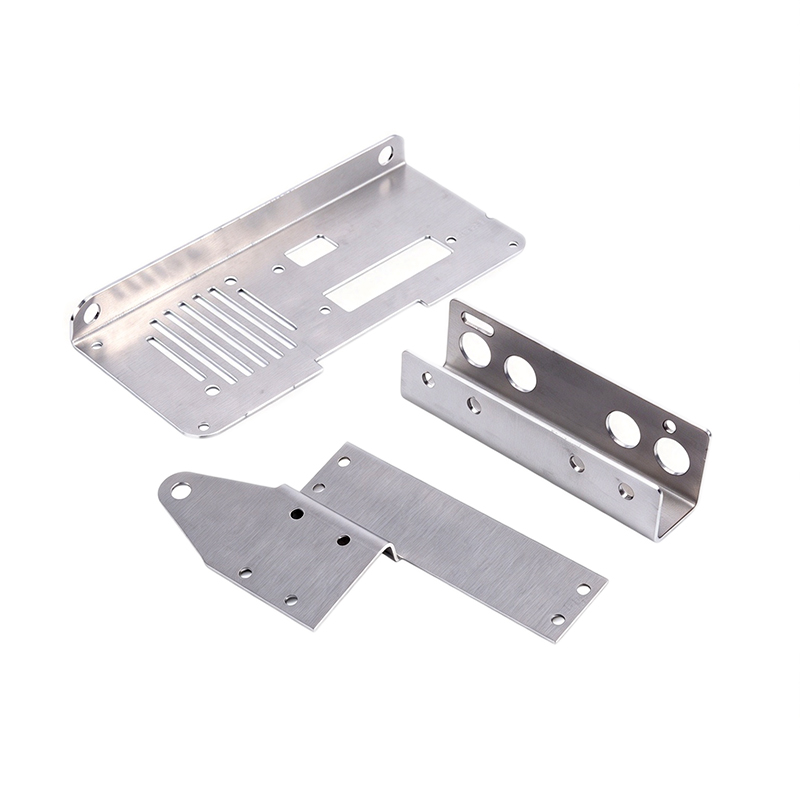
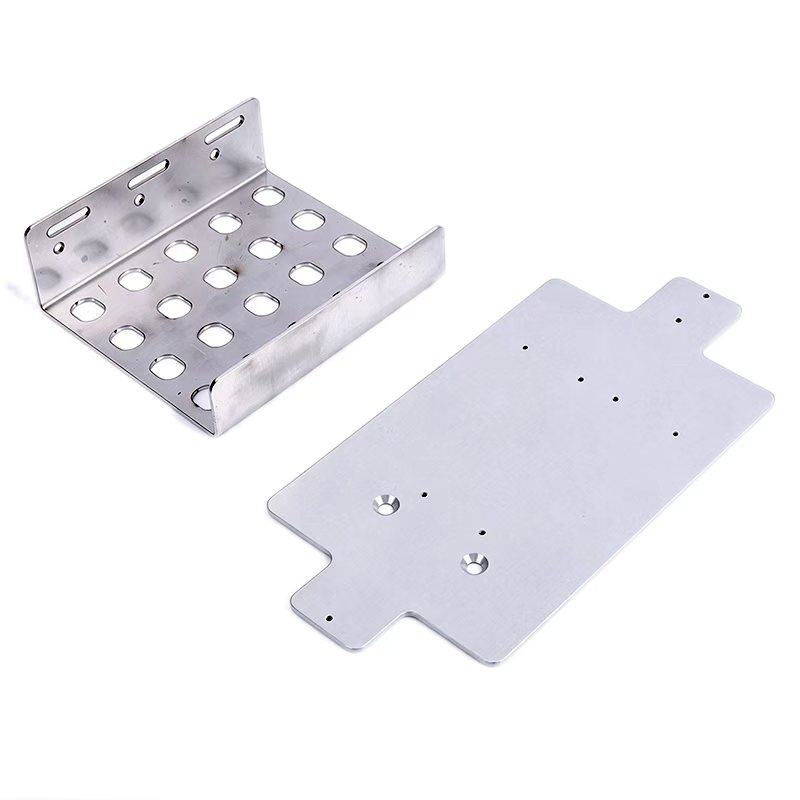
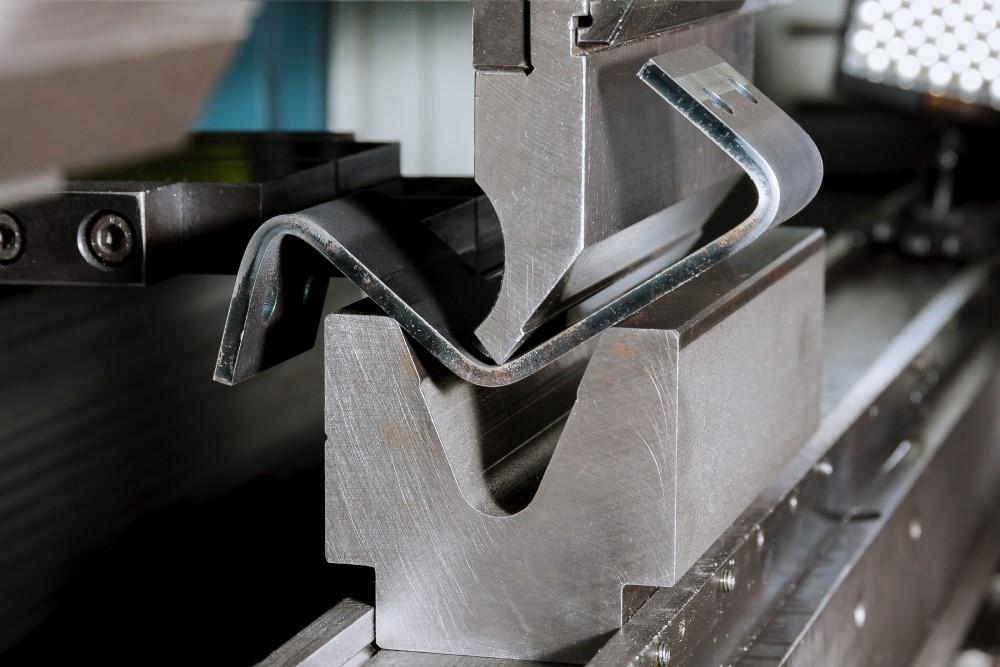
Workers mainly use a press brake for bending. It has a punch on top and a die below, often a V-shape. The sheet rests on the V opening. The punch moves down to push the metal in and form the angle. San Jun Hardware has three AMADA CNC press brakes. These allow tight control of angles for advanced products.

The Fundamental Principle: The V-Die Setup

No matter the method, the aim stays the same: hit the needed bend angle and radius. Yet the punch’s contact with the sheet and die changes the approach.

Air Bending: Flexibility and Minimal Tonnage

Air bending stands as the usual and adaptable way in today’s sheet metal shops. It brings big benefits in variety and speed, but it has its own issues.

Defining the Process: Precision Through Angle Measurement

In air bending, the punch forces the sheet into the V-die. The metal does not touch the bottom sides fully. It rests on the die edges only, with space below. The bend angle comes from how deep the punch goes, not the tool shape. Modern CNC press brakes, like those at San Jun Hardware, handle this depth control well.
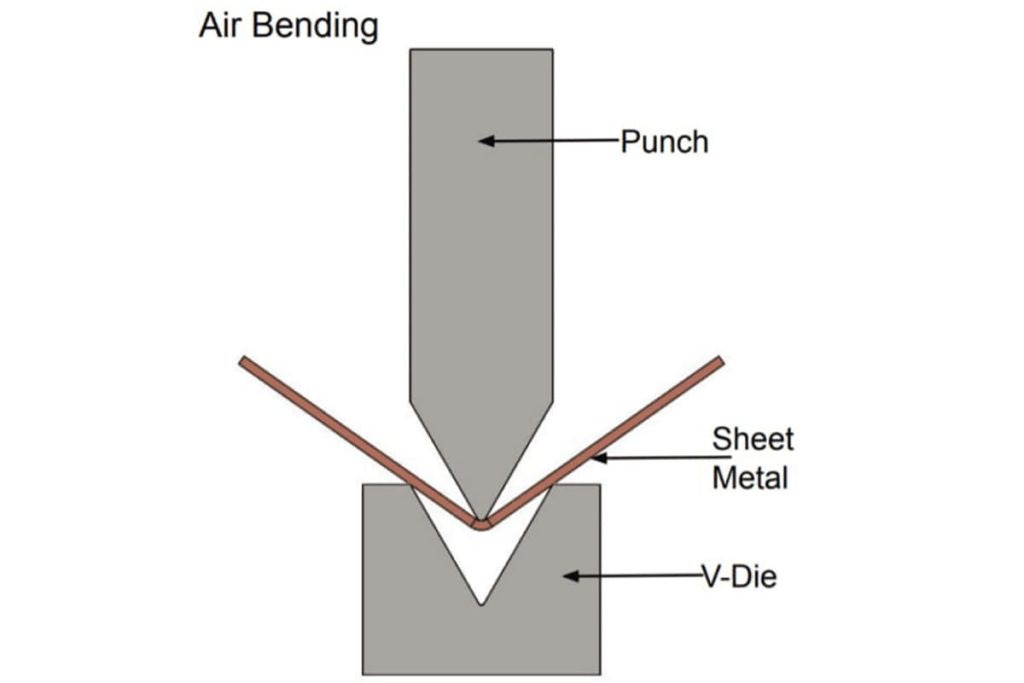
 

Air Bending Precision Through Angle Measurement

Advantages for Complex Geometry and Low-Volume Runs

Air bending needs less pressure than other ways. This suits big parts or thick sheets when machine power is limited. One set of dies, say a 90-degree V, can make many angles—sharp, wide, or right. That cuts setup time and gives more choices. Many shops pick it for varied custom work.

The Challenge of Springback and Material Variability

The main drawback is springback. The metal tries to flatten a bit after pressure stops. Air bending depends on over-bending to fix this. Small changes in sheet thickness or strength can shift the final angle. That makes tight tolerances harder on some jobs.

Bottom Bending (Coining): Achieving Maximum Accuracy and Repeatability

Bottom bending, sometimes linked to coining in its strong form, uses heavy pressure and full contact for steady results and close fits.

Defining the Process: Forcing the Material into the Die

Here, the punch pushes the sheet hard into the die until it touches all sides. The tools match the wanted angle closely. In full coining, a huge force thins the metal slightly and stops springback almost completely. Regular bottom bending applies strong pressure to lock the angle to the tools.
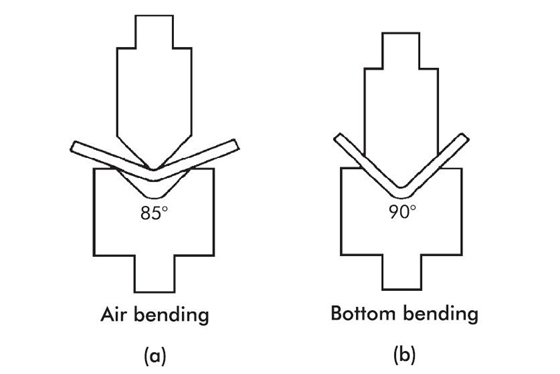
 

Bottom Bending Forces the Material into the Die

Advantages for High Precision and Repeatability

Bottom bending gives better exactness and the same results each time. The metal must follow the tool shape. Angles stay steady even with small material differences. Shops use it for parts needing very close fits, like small custom items or medical equipment.

Disadvantages: Higher Tonnage and Dedicated Tooling

It calls for much more machine power—often three to five times air bending. Different angles or thicknesses usually need special tools. That raises startup costs and switch times.

Precision Bending in Practice: San Jun Hardware’s Approach

For a company like San Jun Hardware that supplies key metal frames to tech fields, using both ways helps meet varied needs. We follow GB/T19001-2008 (idt ISO9001:2008) quality rules.

Leveraging AMADA CNC Press Brakes for Optimal Technique Selection

San Jun Hardware uses its AMADA CNC press brakes for exact control. Air bending suits varied single runs. Bottom bending fits large batches needing steady angles. We hold tolerances like +/- 0.4 mm overall and +/- 0.2 mm from bend to hole.

Case Study: Extreme Resilience (IP65 Outdoor Enclosures)

The Outdoor Custom Digital Signage Shell IP65 faces tough weather. To hit the IP65 rating against water and dust, bends must form tight seals. Steady angles from good bending cut gaps for moisture. Often, aluminum frames help heat escape in hot spots. San Jun Hardware makes custom cases for world markets, fixing issues like cooling in harsh places through accurate bends.

 

IP 65 Design Outdoor Waterproof Touch Display Advertise Enclosure

Strategic Selection: Choosing the Right Bending Method

Picking air or bottom bending depends on part details and run size.

Key Factors: Material, Thickness, and Tolerance Requirements

Prototypes or odd angles with small runs often fit air bending’s quick changes and lower cost. Our team handles the springback math. For top accuracy like +/- 0.1 mm away from bends, bottom bending works better, even with more power needed. San Jun Hardware handles materials from stainless steel to aluminum and cold-rolled steel, through full steps to checks.

Design for Manufacturability (DFM) and Cost Optimization

We give drawing reviews to spot issues early. Using air bending for varied shapes and bottoms for key spots helps cut costs and speed jobs while keeping quality high.

Conclusion: Bending Excellence Driving Industry Solutions

Bending sheet metal looks basic, but it drives success in today’s complex items. From cases for Intelligent Self-service Cabinets to new energy parts or busy display units, the pick between air and bottom bending balances needs. With skilled staff and AMADA CNC press brakes, San Jun Hardware delivers reliable quality at fair prices. Every part gains the strength and fit to help products hit markets fast.

FAQ

Q: Which bending method does San Jun Hardware typically use for its custom kiosk enclosures?  

A: San Jun Hardware employs advanced CNC press brakes, such as AMADA CNC press brakes, and selects the optimal technique (either air bending for versatility or bottom bending for high precision) based on the material, tolerance requirements, and design complexity of the specific enclosure.

Q: What materials are available for the precision bending processes?  

A: We work with a variety of materials, including cold-rolled steel, electrolytic steel, galvanized steel, stainless steel, and aluminum, tailored to application requirements like corrosion resistance or strength.

Q: How does precision bending ensure the waterproof rating for the Outdoor Custom Digital Signage Shell IP65?  

A: Precision bending ensures minimal variation in angles and straight edges, which is critical for creating tightly fitted joints and reliable sealing surfaces necessary to maintain the IP65 waterproof and dustproof rating in harsh outdoor environments.

Q: What tolerances can San Jun Hardware achieve during the bending process?  

A: Typical bending tolerances for forming and bending are +/- 0.4 mm, and precision positioning tolerances for bend to hole or features are +/- 0.2 mm.
Tags:

Leave a comments

    Your Name*
    Your Email*
    Your Tel*
    Your WhatsApp *
    Message*
    No file selected

    Table of Contents

    FAQ

    Yes. We support 1PC MOQ, no mold tooling required. All custom sheet metal enclosures can be produced directly per your design.
    Yes, we accept custom sheet metal fabrication strictly based on your 2D/3D drawings. We provide free DFM checking, follow your exact material, tolerance and finishing requirements. Both prototype and mass production are available with full quality control and export standard packaging.
    Absolutely. Send us your product size, assembly function, usage scenario and performance demands. Our sheet metal team offers free structural design, solution tuning and DFM analysis. You don’t need to prepare drawings; we finish all design work from sketch to production drawing to save your R&D cost and risks. We revise drawings repeatedly to meet your assembly needs perfectly.
    We provide 24H DFM drawing review and formal quote after receiving your technical requirements.
    Yes. We offer fast prototype sampling according to your drawings, helping you verify structure and size before bulk order.
    All our products have obtained ISO9001, EMC, LVD and RoHS certifications. We fully comply with global safety and quality standards, delivering stable, trustworthy solutions for all project applications.
    We operate our own factory and provide one-stop full in-house production. Strict process control and standardized quality management guarantee stable product quality and punctual delivery, building reliable long-term global partnerships.
    We process a full range of standard and high-performance sheet metal materials, including stainless steel (304/316), aluminum (5052/6061), cold/hot rolled steel, galvanized steel, brass and copper. We can also source special materials according to your project requirements.
    Our standard machining tolerance is ±0.1mm for laser cutting and bending. For high-precision parts, we can reach ±0.05mm based on material thickness and part structure. All dimensions are 100% inspected before delivery to meet your requirements.
    Yes, we provide one-stop full surface treatment services, including powder coating, painting, anodizing, sandblasting, brushing, electroplating, passivation, polishing and heat treatment. We can customize colors and effects according to your design.
    Yes, we always sign NDA (Non-Disclosure Agreement) before receiving any drawings or design details from customers. We strictly protect your intellectual property and keep all your projects confidential.
    Latest Product

    Check out our Product

    View More
    Custom 3-Door Metering Distribution Box, Outdoor Waterproof & Dustproof Meter Cabinet Sheet Metal Fabrication

    Custom 3-Door Metering Distribution Box, Outdoor Waterproof & Dustproof Meter Cabinet Sheet Metal Fabrication

    <p>SanJun Hardware is a professional sheet metal factory specialized in custom three-door metering distribution cabinets for global power engineering, property management and energy enterprises.<br /> Most overseas purchasers face big troubles: no ready-made cabinet drawings, high design costs, water leakage & dust ingress outdoors, cabinet bending deformation, messy internal wiring layout and inconsistent assembly gaps. We fully solve all these industry pain points with our core service: totally free engineering drawing design, customers don’t need to provide any self-drawn sketches.</p> <p>We own full production lines for laser cutting, CNC bending, full sealing welding, rainproof structural processing and weather-resistant coating, with machining tolerance controlled within ±0.1mm. Our 3-door meter cabinets reach IP54/IP65 waterproof dustproof standard, pass ISO9001 & RoHS certification, widely used in all kinds of indoor and outdoor power metering scenarios worldwide.</p>
    Read More
    PV Solar AC Distribution Cabinet Sheet Metal Enclosure Manufacturer

    PV Solar AC Distribution Cabinet Sheet Metal Enclosure Manufacturer

    <p>SanJun Hardware manufactures precision custom sheet metal photovoltaic AC distribution cabinet enclosures for global solar industry clients.</p> <p>We eliminate common customization headaches including expensive outsourced design work and structural defects, providing <strong>free CAD drawing design with no client drafts needed</strong>.</p> <p>Supported by full automatic sheet metal processing, our cabinets achieve tight machining tolerances and comply with ISO9001, RoHS, IP54/IP65 for indoor & outdoor photovoltaic applications.</p>
    Read More
    Custom Non-Standard Blade Battery Box Enclosure

    Non-Standard Blade Battery Box Metal Enclosure & New Energy Energy Storage Chassis Housing Fabrication

    <p>SanJun Hardware is a professional non-standard precision sheet metal processing factory based in Rugao, specializing in customized metal housings for blade battery packs and new energy energy storage chassis for global new energy enterprises.<br /> Most overseas buyers face huge troubles when customizing non-standard battery cabinets: lacking structural design drawings, high independent design costs, poor cabinet structural strength, insufficient outdoor waterproof and anti-corrosion performance, and inconsistent assembly gaps. We completely solve these industry pain points with our exclusive service: completely free production-ready CAD drawing design, customers do not need to provide any self-drawn drafts.<br /> Our full-process sheet metal workshop realizes integrated production from laser cutting, CNC bending, full penetration welding to weather-resistant surface coating, with machining tolerance controlled within ±0.05mm~±0.1mm. All non-standard blade battery boxes and energy storage chassis comply with ISO9001, RoHS and IP protection standards, widely applied to household energy storage, industrial & commercial energy storage, new energy vehicles, RV power supply, off-grid solar energy storage and other global scenarios.</p>
    Read More
    Off-Grid New Energy Battery Integrated Cabinet Enclosure

    Custom Off-Grid New Energy Battery Integrated Cabinet Sheet Metal Enclosure

    <p>SanJun Hardware is a specialized precision sheet metal manufacturer for new energy, dedicated to custom off-grid integrated battery cabinet enclosures for global energy storage integrators and power equipment brands.<br /> Most overseas buyers struggle with unavailable structural drawings and exorbitant industrial design costs for cabinet customization—we break this industry bottleneck by offering 100% free full-grade 2D & 3D drawing design, no design drafts required from clients.<br /> Our professional engineering team thoroughly resolves core industrial pain points: heavy-load cabinet sagging deformation, substandard outdoor waterproof & dustproof performance, uneven assembly gaps, and weak anti-corrosion capacity. We deliver standard machining tolerance of ±0.1mm and ultra-precision custom tolerance up to ±0.05mm. All sheet metal enclosures pass ISO9001, RoHS, EMC and LVD certification, fully adaptable to all indoor & outdoor off-grid energy storage scenarios worldwide.</p>
    Read More

    Clients We've Served

    logo1
    logo2
    logo3
    logo4
    logo5
    logo6
    logo7
    logo8
    logo10
    logo11
    logo12
    logo13
    logo14
    logo15
    logo16
    logo17
    logo18
    logo19
    logo20
    logo21
    logo22
    Home
    WhatsApp
    Email
    Contacts